Facebook advertising looks a lot different in 2026, mostly thanks to new AI tools, updated targeting, and tighter privacy rules. The platform now uses the Andromeda algorithm and AI creative generation, so a lot of what we used to do manually is now automated.
These days, we need to focus on creative diversity and first-party data because Facebook’s AI handles most of the optimisation and targeting for us.

Advertisers in Europe are working under different rules than those in the US and other regions. The complete guide to creating high-performing ads in 2026 points out that varied creative content is now more important than complex targeting.
Server-side tracking through Conversions API is now a must, since traditional pixel tracking just isn’t as reliable anymore.
This guide covers what you need to know about running Facebook ads this year. We’ll look at new ad formats, how to structure campaigns, and which measurement tools still work in a privacy-first world.
Whether you’re running ads for a small business or a big brand, knowing about these changes helps you stay competitive in an increasingly automated ad space.
Key Takeaways
- Facebook’s AI now handles targeting, so creative quality and variety are key to campaign success.
- Server-side tracking through Conversions API is required for accurate measurement as cookies fade out.
- European advertisers face different compliance rules than US marketers, which affects targeting capabilities.
Core Updates to Facebook Ads in 2026
Meta introduced big changes to its ad platform in early 2026 that really shake up campaign performance. The Andromeda algorithm now reads your creative to figure out targeting, AI makes smarter delivery choices, and new placements like Threads are available while some old ones are gone.
Key Platform Changes and Trends
The Andromeda algorithm is a huge shift in how Meta shows ads. It actually looks at your creative—images, copy, tone, and context—to decide who should see your ad.
For example, if you upload an ad with someone in gym wear and pre-workout copy, the system will read that differently than an ad aimed at older adults with joint pain messaging. Your creative is now the main targeting tool.
This is why broad targeting campaigns started to beat tightly targeted ones in 2025. The algorithm was already moving this way before Andromeda made it official.
Instagram Explore placement disappeared in January 2026. Now, tapping a post opens a Reels viewer, and Meta quietly moved affected ad sets to other placements.
Threads ads are now available worldwide after Threads hit 400 million monthly users. Right now, inventory is cheap because there’s more supply than demand, but that probably won’t last.
Impact of AI and Automation
GEM, Meta’s Generative Ads Recommendation Model, now uses sequence-learning to understand user behavior over time. It can spot someone close to buying versus someone just browsing.
Meta doubled the GPU training power for GEM in late 2025. This led to a 3.5% jump in ad clicks on Facebook and a 1% lift in Instagram conversions.
If you’re running a big budget, even a 3% conversion lift can mean thousands more in return from the same spend.
GEM doesn’t work as well if your Pixel is glitchy, if your budget is too tight for campaigns to exit the learning phase, or if you’re running CAPI without the Pixel (or vice versa). Meta says using both together gives the best results.
Advantage+ Creative’s AI tools are way better now. The image-to-video tool can turn up to 20 product images into multi-scene video ads.
Automated brand controls now let you lock logos, fonts, and colors so AI-generated versions stay on-brand.
Evolving Role of Meta Advertising
Meta Lattice replaced the old surface-by-surface ad evaluation with a single, unified quality model. It now scores ads across placements more consistently.
Lattice looks at estimated action rate, quality ranking versus other ads, and engagement rate ranking. Ads with high quality scores cost less to run, while lower scores mean higher CPMs and less reach.
Click-to-WhatsApp ad revenue jumped over 50% year-over-year in the US during late 2025. Meta added a “Chat on WhatsApp” objective for lead gen, so users can message you directly instead of landing on a website.
A new Conversion Count breakdown splits out “First Conversion” and “All Other Conversions” at every level. This helps you see if you’re getting new customers or just repeat buyers.
Latest Facebook Ad Formats and Their Specifications
Meta updated its Facebook ad formats for 2026 with higher-res requirements and more placement options across Facebook, Instagram, and Threads. The new specs make sure your visuals look sharp on high-density screens and work across different ad types.
Overview of Ad Formats
There are several main Facebook ad formats to choose from, depending on your goals. Image ads are straightforward—just a photo and some text, perfect for feeds and stories.
Video ads let you share moving content to grab attention and tell a story.
Carousel ads let you show up to ten images or videos in one ad, each with its own link. They’re great for multiple products or step-by-step demos.
Collection ads mix a cover image or video with product images below, making for a mobile shopping experience.
Instant Experience ads (formerly Canvas) give users a full-screen, interactive experience that loads instantly. The newest format is Reels ads, which show up between organic Reels and offer vertical, full-screen engagement.
All these formats support multiple placements like Facebook Feed, Stories, Marketplace, right column, and in-stream videos. You can also run them on Instagram and Messenger for more reach.
Design Specifications and Technical Requirements
Meta now recommends higher resolutions for 2026 to keep visuals crisp. For square images (1:1), use 1440 x 1440 pixels.
Vertical ads look best at 1440 x 1800 pixels (4:5 ratio), and for Stories or Reels, use 1440 x 2560 pixels (9:16 ratio).
You get a little wiggle room—about 3% aspect ratio tolerance for most placements. Just remember to keep key elements (like logos or text) inside safe zones so they don’t get cropped.
| Format | Recommended Resolution | Aspect Ratio | File Type | Max File Size |
|---|---|---|---|---|
| Square Image | 1440 x 1440 | 1:1 | JPG or PNG | 30 MB |
| Vertical Image | 1440 x 1800 | 4:5 | JPG or PNG | 30 MB |
| Stories/Reels | 1440 x 2560 | 9:16 | JPG or PNG | 30 MB |
| Video | 1080 x 1080 minimum | Various | MP4 or MOV | 4 GB |
Video ads can be up to 241 minutes, but shorter videos usually do better. Try to keep text overlays minimal—too much text can hurt your reach.
Format Selection Strategies
Pick your format based on your campaign goals and the story you want to tell. Image ads are great for brand awareness or when you have one strong visual—they’re quick to load and easy to make.
Video ads are perfect for showing off product features, sharing testimonials, or building an emotional connection. For best results, keep videos under 15 seconds, especially in the Feed where people scroll fast.
Carousel ads shine when you want to show a product range, highlight features, or tell a story in steps. Each card can have its own link, which is awesome for e-commerce.
Collection ads let users browse products right on Facebook, making them ideal for retail brands.
Placement asset customisation means you can upload different images for Feed, Stories, etc., so your ads look their best everywhere. This flexibility helps you stay on-brand and reach more people across Meta’s apps.
Audience Targeting and Segmentation in 2026

Targeting on Facebook is way different than even a year ago. Meta has cut back on manual controls and now pushes advertisers toward broader audiences, letting automation do most of the heavy lifting.
First-party data and lookalike modeling are now essential for finding the right people.
Advantage+ Audience and Automation
Advantage+ targeting is now the default for most new campaigns. If you set age, gender, or location, Meta treats these as suggestions, not strict limits.
The system expands or narrows your audience based on performance data. This works best if you feed the algorithm quality conversion data, so having good pixel tracking and Conversions API setup is critical.
Without clean data, Advantage+ struggles to find high-intent users. Ads should appeal to broad groups, not just one narrow persona.
Meta’s automation has made interest-based targeting less important and put more weight on creative quality. If you give the system strong creative and clear conversion events, it’ll find your buyers.
First-Party Data and Custom Audiences
Custom audiences matter more now that detailed targeting options are shrinking. You can upload customer lists, retarget website visitors, or build segments based on specific actions people took.
Some top uses:
- Retargeting users who viewed products in the last 7 days
- Uploading CRM segments to exclude existing customers
- Building audiences from high-value buyers
- Targeting people who abandoned their carts
You can also exclude converters using pixel data or customer files. This keeps your bottom-of-funnel ads focused on people who haven’t bought yet.
First-party data gives you more control now that interest targeting isn’t as powerful.
Lookalike Audiences and Retargeting
Lookalike audiences help us find people similar to our best customers. A 1% lookalike based on high-value purchasers usually beats generic interest targeting.
It’s better to build lookalikes from specific customer segments, not broad lists. For example, a lookalike of customers who spent over £200 is more precise than one based on all website visitors.
Retargeting still works, but we need to approach it differently now. Instead of using exclusions, we rely on time windows and pixel events to separate funnel stages.
Someone who watched a video gets different messaging than someone who abandoned checkout. We can layer these audiences by behaviour and timing to keep our ads relevant.
Creative Strategies and Best Practices
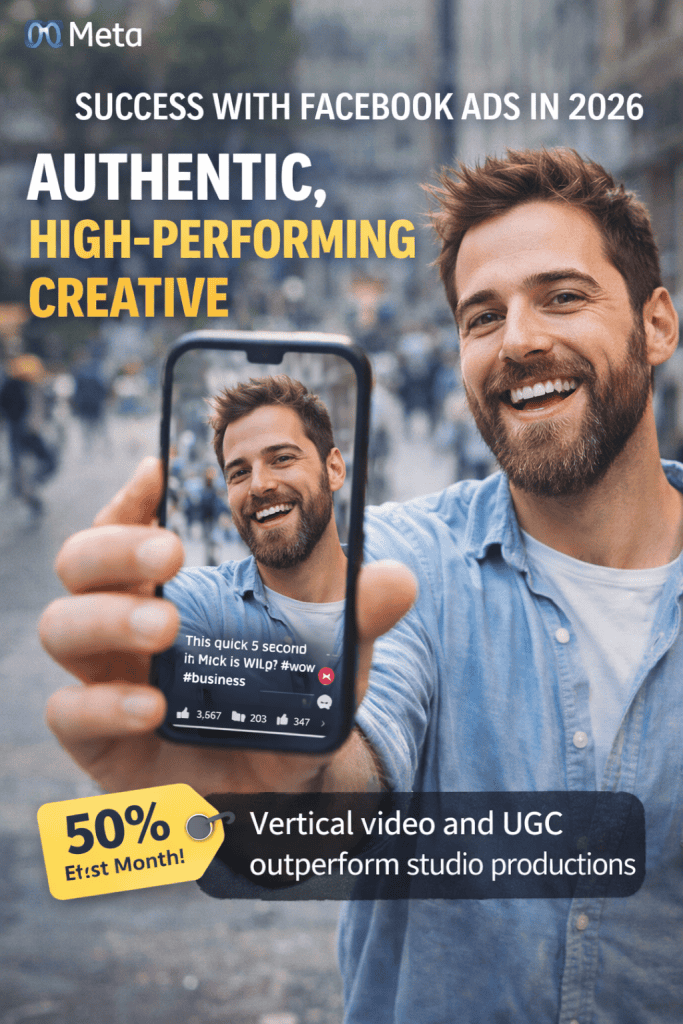
Success with Facebook ads in 2026 is all about authentic, high-performing creative that actually connects with people. Vertical video and user-generated content (UGC) now outperform polished studio productions.
Systematic creative testing helps us figure out what actually drives conversions.
Ad Creative Essentials
Authentic content is the foundation of strong Facebook ads. Vertical video formats are everywhere because they blend right into Reels and Stories.
Filming ad creative on smartphones gives us that raw, genuine look people trust. User-generated content, like customer testimonials and product demos, consistently beats branded content.
One e-commerce brand saw a 30% drop in cost per click after switching to customer-filmed content. That’s a huge difference.
Key elements for effective ad creative:
- Strong hooks: Grab attention in the first three seconds with a question, bold statement, or eye-catching visual.
- Captions: Most people watch with sound off, so readable text is a must.
- Single focused message: Stick to one pain point or benefit per ad.
- Native feel: Use trending audio and casual filming styles that fit right into users’ feeds.
Tools like Canva make static image creation easy, and Descript is great for editing vertical videos. Facebook video ads should be 15-30 seconds to keep people watching.
Creative Testing and Dynamic Creative
High-velocity creative testing lets us find winners fast instead of obsessing over a single ad. The 3×3 testing method is a simple framework: test three hooks, three visual formats, and three ad copy angles at the same time.
Dynamic creative takes this up a notch by letting Meta’s algorithm mix and match headlines, descriptions, images, and videos. The system finds the best combos and shifts budget to top performers automatically.
We should check ad testing results after 3-5 days. High click-through rates mean the creative is grabbing attention. Low cost per purchase means it’s converting.
Look for these early signs:
- CTR above 2%: The ad stops the scroll.
- Video completion rate above 25%: People are interested.
- Cost per click going down: Engagement is improving.
Creative testing is about volume and iteration, not perfection. Launch multiple variations every week and scale the ones that work.
Effective Calls to Action and Value Proposition
Our call to action (CTA) should tell people exactly what to do next. Generic buttons like “Learn More” don’t work as well as specific CTAs like “Get Your Free Plan” or “Take the 2-Minute Quiz.”
The value proposition should explain why someone should act now. Good ad copy grabs attention in the first line, highlights the problem, and then offers a solution.
Strong value propositions:
- Promise specific outcomes, not just vague benefits.
- Use time-sensitive offers to create urgency.
- Show social proof, like customer numbers or ratings.
- Make it clear how you’re different from competitors.
Match your CTA to where the customer is in their journey. Cold audiences need educational CTAs like “See How It Works.” Warm audiences respond better to direct CTAs like “Shop Now” or “Start Free Trial.”
The right value prop and CTA combo is what gets people to take action.
Optimising Campaign Structure and Funnel Stages
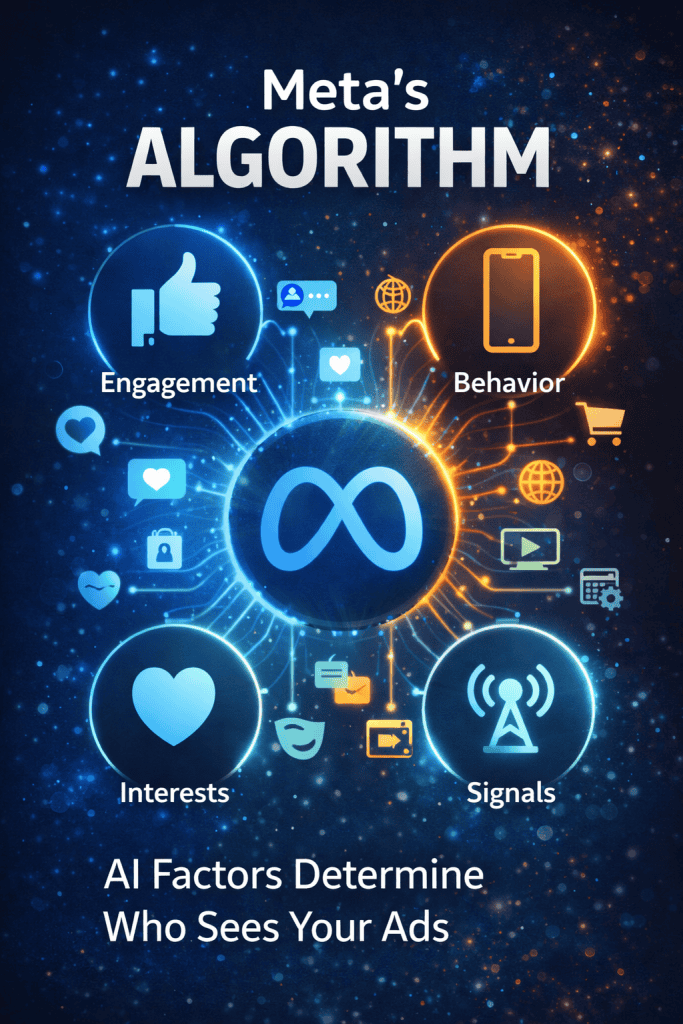
How you set up your campaigns affects how well your ad spend turns prospects into customers. The best campaign structures in 2026 work with Meta’s algorithm, not against it.
Funnel stages help us show the right message to the right audience at the right time.
Campaign Objectives and Budget Allocation
Pick one clear campaign objective that matches your business goal. For e-commerce, choose Sales. For lead generation, pick Leads.
Mixing objectives just confuses the algorithm and hurts performance. Let the platform decide budget allocation.
Start with budgets that make sense for your average order value and cost per acquisition goals. A good rule: allocate at least 50 times your target cost per result as a daily budget to give the algorithm enough data.
Split your ad spend across different funnel stages. Top-of-funnel prospecting usually gets 60-70% of the budget. Middle-of-funnel retargeting gets 20-30%. Bottom-of-funnel conversions get the rest.
Each campaign should aim for at least 50 conversion events per week to exit the learning phase. If you’re not hitting that, increase your budget or combine campaigns.
Structuring Campaigns for Performance Marketing
For performance marketing, it’s best to run separate campaigns for each funnel stage. Cold audience campaigns target people who’ve never interacted with your brand.
These use broad targeting with different creative angles so the algorithm can find new customers. Aim for 4-6 ad creatives running at once.
Warm audience campaigns go after people who’ve engaged with your content or visited your website but haven’t converted. Use messaging that handles objections or shows social proof.
Hot audience campaigns focus on cart abandoners and high-intent visitors. These need smaller budgets but often deliver the best return on ad spend.
Avoid audience overlap by using exclusions. Your cold campaign should exclude anyone who’s visited your website in the past 180 days.
Leveraging CBO and Funnel Stage Strategies
Campaign Budget Optimisation (CBO) lets Meta shift ad spend between ad sets based on performance. Knowing your funnel stages helps you create the right message for each audience.
Top-of-funnel ads are about awareness and education. Use attention-grabbing hooks and broad value props, but don’t push for a purchase right away.
Middle-of-funnel ads tackle pain points and show off product benefits. Customer testimonials and demo videos work well here.
Bottom-of-funnel ads create urgency with limited-time offers or risk-free guarantees. Dynamic product ads can show people exactly what they looked at on your site.
CBO works best with at least two ad sets in a campaign. The algorithm will move budget to the best performer. Don’t use CBO with just one ad set—there’s nothing to optimise.
Recommended CBO Setup:
- Minimum daily budget: £50
- Ad sets per campaign: 2-4
- Ads per ad set: 4-6
- Bid strategy: Lowest cost
Measurement, Attribution, and Analytics

Meta changed how click-through attribution works in March 2026, making it more like Google Analytics. Now we have clearer tracking tools and better attribution models that separate link clicks from social engagement.
Conversions API and Facebook Pixel Updates
The Conversions API works with the Facebook Pixel to track user actions more accurately. We need both tools because browsers are getting tougher on cookies and tracking scripts.
Pixel tracks client-side actions like page views and purchases in real time. The Conversions API sends server-side data directly to Meta, dodging browser restrictions.
Benefits of running both:
- Less data loss from ad blockers
- Better attribution across devices
- Improved conversion probability scoring
- More reliable tracking for iOS users
Set up event matching so Pixel and API data connect properly. This means passing info like emails, phone numbers, and external IDs through both systems.
Key Performance Metrics: CPM, CPA, ROAS
We focus on three main metrics to measure campaign performance and guide budgets.
CPM (Cost Per Mille): How much we pay for 1,000 ad impressions. Lower CPM means more reach for less money.
CPA (Cost Per Acquisition): What we pay for each conversion. Just divide total ad spend by the number of conversions.
ROAS (Return on Ad Spend): How much revenue we get for each pound spent. A 4:1 ROAS means £4 earned for every £1 spent.
Meta’s Lattice tech now predicts conversion probability, helping us spot users most likely to convert.
Cross-Platform Reporting Tools and Insights
Meta now works with analytics tools like Northbeam and Triple Whale to create unified dashboards. These combine Meta data with other marketing channels.
It’s important to understand attribution models. Click-through attribution now only counts link clicks. Engage-through tracks likes, shares, and saves separately.
The engaged view threshold for video ads dropped from 10 seconds to 5 seconds, since nearly half of conversions happen within 2 seconds of viewing Reels. This makes attribution more accurate for short-form content.
We should expect lower reported click-through conversion numbers, since Meta now separates direct response from social proof. This gives us a clearer picture of what’s actually driving purchases.
Compliance and Policy Considerations
Meta’s advertising rules now apply across Facebook, Instagram, Messenger, and Audience Network. Breaking the rules can mean ad rejections, account restrictions, or even permanent bans.
Ad Policy Changes and Enforcement
Meta’s ad standards protect users from unsafe and discriminatory practices, prevent fraud, promote positive experiences, and make ad sponsors transparent.
You can’t advertise illegal products, drugs, weapons, counterfeit goods, or anything that breaks local laws. Tobacco, unregulated supplements, and discriminatory content are also out.
Some categories are allowed but with restrictions. Financial services need written Meta approval for things like crypto. Payday loans and high-interest short-term loans are banned. Political and social issue ads need special authorisation and must say who paid for them.
Meta uses machine learning to review ads for policy violations, image and text compliance, landing page quality, and user experience. If your ad gets rejected, you can request a review through Ads Manager or contact Meta Business Support.
Privacy, Data, and Attribution Regulations
Meta now categorises businesses by product type, which affects how we track and target. Health and wellness businesses can’t send Meta personal info, including mid- and lower-funnel data.
Make sure your landing pages work well, are mobile-friendly, and load fast. The content needs to match your ad promises—no misleading info or bait-and-switch.
When building custom and lookalike audiences, follow data privacy rules and retarget responsibly. Use demographic filters carefully and avoid anything that could trigger account restrictions.
Frequently Asked Questions
Meta’s 2026 advertising platform uses AI-driven systems that focus more on creative diversity than manual targeting. Budget requirements and visual guidelines have changed to match new algorithmic priorities and cross-platform integration.
How can Meta’s evolving advertising algorithms optimise campaign results in 2026?
The Andromeda algorithm now processes 10,000 times more ad variants in parallel compared to older systems. We don’t need to rely on detailed manual targeting anymore because the algorithm matches ads to the right people based on behavioural predictions.
Meta Lattice, the prediction system behind ad delivery, learns from user interactions across Facebook, Instagram, WhatsApp, and Threads. It builds a broad understanding of user intent without tracking individual cookies.
The algorithm rewards creative diversity. If we upload a bunch of similar ads, the system groups them and might even increase costs, so it’s better to make ads that are truly different and appeal to different psychological triggers.
Server-side tracking through the Conversions API (CAPI) is now key for accurate measurement. The algorithm performs better when it gets clean, reliable conversion data directly from our servers, not just pixel tracking.
What is the minimum daily budget that is considered effective for Facebook advertising this year?
Media inflation trends have affected CPM benchmarks in 2026. The minimum effective budget depends on what your campaign is trying to do and how competitive your market is.
For conversion campaigns, it’s best to budget at least £20-30 per day per ad set. This gives the algorithm enough data to optimise.
Lower budgets often struggle to exit the learning phase, which usually needs about 50 conversion events within seven days. Brand awareness campaigns can work with smaller budgets, around £10-15 daily, but more competitive industries will need higher investment to stay competitive.
Geographic targeting matters too. Campaigns targeting the EU may perform differently because of the “Pay or Consent” model, which affects audience sizes and signal quality.
Can you explain the updated principles behind the 20% text rule in Facebook ad visuals?
Meta got rid of the strict 20% text rule a while ago, but text density still impacts ad performance in 2026. The algorithm won’t reject ads with lots of text, but it might reduce their reach or make them more expensive.
We should focus on image specs and visual quality instead of worrying about exact text percentages. Ads with less text usually get better engagement because they blend in better with the feed.
The system uses computer vision to check visual content, including text placement and density. Ads that look too promotional or cluttered get lower priority compared to clean, visually appealing ones.
It’s better to keep the main message in the ad copy, not on the image itself. This way, the algorithm can test different text variations using Advantage+ Creative features.
What strategies are recommended for deploying the 3-2-2 model in Facebook advertising campaigns?
The 3-2-2 model is a classic campaign structure—three campaigns, two ad sets each, and two ads per set—but rigid frameworks are less important now as Meta pushes for simpler setups.
In 2026, the “Power of Two” account structure is working better. This means running one Advantage+ Shopping campaign and one manual campaign for testing, instead of splitting everything up.
It’s smarter to focus on creative diversity within fewer campaigns, rather than spreading your budget thin across lots of ad sets. The algorithm does better with consolidated budget and data.
If you do use a 3-2-2 approach, make sure each ad is a genuinely different concept—like a studio video, user-generated content, and a static image, not just small tweaks of the same idea.
What are the latest targeting options available for Facebook advertisers in 2026?
Manual targeting is mostly outdated as the algorithm now handles audience selection. Advantage+ campaigns usually outperform detailed targeting for most advertisers.
You can still set broad parameters like location, age, and language, but detailed interest-based targeting doesn’t matter much anymore. The algorithm finds high-intent users based on behaviour, not just stated interests.
Lookalike audiences have evolved into broader “Advantage Lookalike” options that automatically expand beyond your original audience. The system finds similar users across all Meta platforms without needing you to set percentage ranges.
Custom audiences from your customer lists are still great for retargeting and exclusions. Just make sure your customer files are clean and synced through CAPI for best results.
How can businesses integrate Facebook ads with other Meta platforms for a unified advertising approach?
We can now run ads across Facebook, Instagram, Threads, and Messenger using unified placement options. Advantage+ placements automatically distribute our budget to the best-performing spots across all these platforms.
Threads has grown as an advertising platform in 2026, offering conversational ad formats that are great for text-based engagement. These ads show up within discussion threads and work well for brands with strong communities.
WhatsApp integration lets us drive conversations straight from ads. Business accounts can set up click-to-WhatsApp campaigns to start customer service chats or answer product questions.
It’s important to make sure our creative assets fit different aspect ratios and contexts. For example, a square video made for Instagram Feed might need some tweaks for Stories or Threads.
Ray-Ban Meta smart glasses now offer “glanceable” ad experiences for early adopters. This inventory is still limited, but brands testing these formats are getting early insights into wearable advertising.